
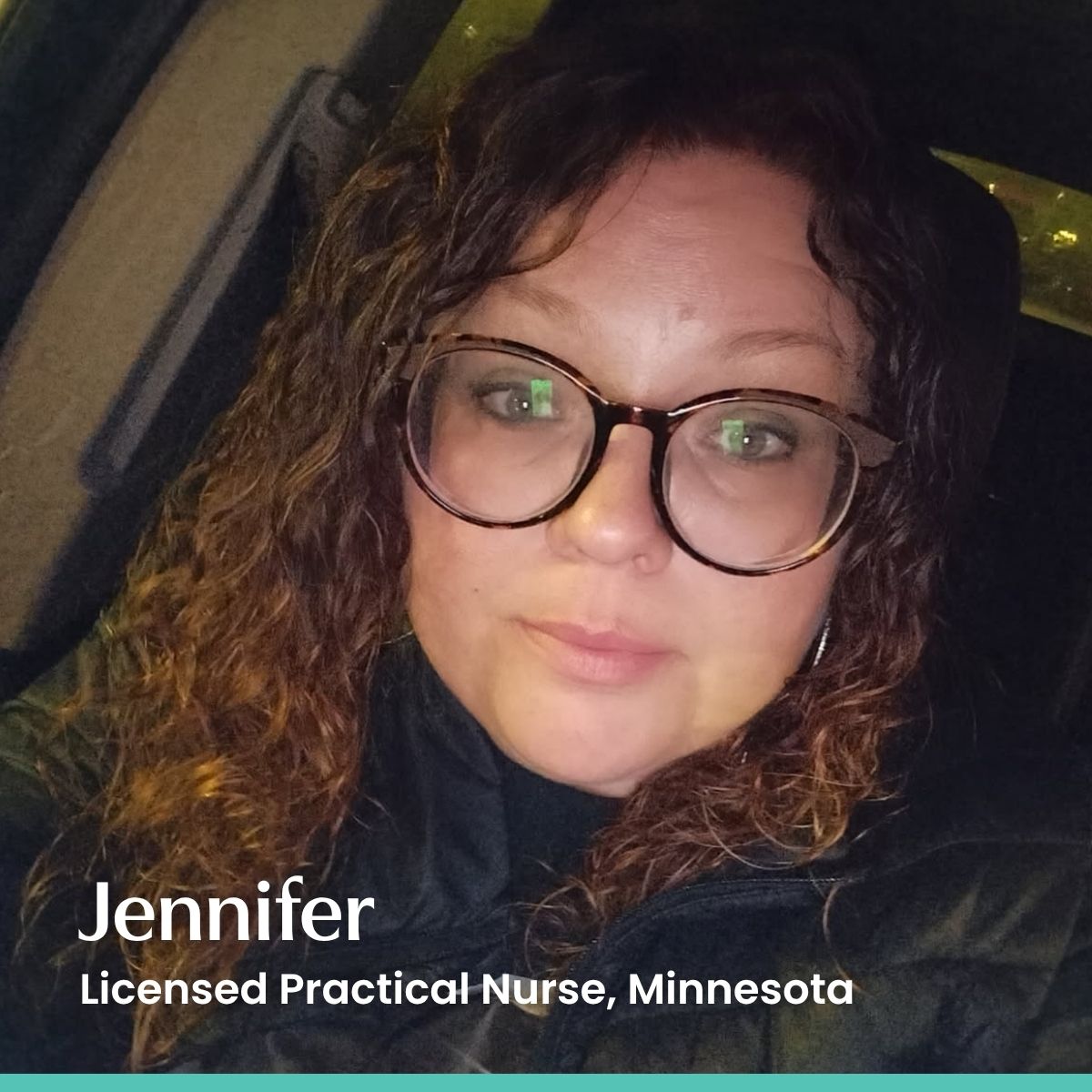
Name: Jennifer
Role: Licensed Practical Nurse (LPN)
Tenure: 10 years
My name is Jennifer Mucha. I am an LPN for REM Community Services in Woodvale, MN. In August I’ll celebrate my 10-year anniversary with the company.
Congratulations! What drew you to the organization?
My aunt has intellectual disabilities. So when I was younger, when we'd go to my grandma's and I would be the one with her for most of the time. Then when I was 16, I started working in a nursing home. I became a Certified Nursing Assistant (CNA) and Trained Medication Administration (TMA) all prior to going through nursing school. Then when I graduated, I stayed at the nursing home for a very short time before I came here.
I've also had many family members work for REM Community Services. My aunt retired after 40 years and she was a cook, a DSP, and a Program Supervisor. My cousin worked as a DSP in this location for 20 years. And my mother was in our region as a nurse for 12 years, and has been with us as an LPN in a different region for almost five years. We’ve had other family members throughout the years work for REM as well. So yeah, it's a family thing.
If you were describing your role as an LPN in our world, caring for individuals with intellectual and developmental disabilities, versus being an LPN at a hospital or nursing home, or private practice, what are some of the differences that somebody considering this work should really think about?
Every day is different. You could be working with people from 18 to 82 years old, and I have a lot of people with mental health issues in addition to the intellectual and developmental disabilities. It's not like a nursing home, where you’re working with only geriatric people. You’re not pushing a med cart, you're not passing meds every single day.
When you go into our homes you have the time to get to know your individuals, not like a nursing home or hospital where you’re always going, going, going. Here I can go in and I sit down and I have conversations to get to know these guys. I think that is one of the biggest things that helps me be able to care for them medically too. Actually, having the time to get to know them, and maybe research more about some of their medical diagnoses.
It sounds like you have the opportunity to really build relationships with these people and you're not feeling rushed.
Yes, you do. And I think that's important for people to realize when they come in. I’ve been with these individuals for over the 10 years, and building these relationships has been critical because it’s meant that they've been able to come and talk to me about concerns or medical things that are going on when they happen. Maybe they wouldn't have expressed their concerns to other staff that have been there because I made them feel comfortable by saying, “Here I am. I want to get to know you and I want to know more about how you're feeling and what's going on.” And then we go from there, building that trust. You don't have that opportunity in a different nursing setting.
You mentioned that you've got some mental health challenges with individuals in your care. What do mental health issues look like in in your world?
It varies. A gentleman in one of my homes is schizophrenic, and there are challenges with that diagnosis on top of his intellectual disabilities. With my younger women it’s more the mental health piece connected to behavior. I do have some women with schizophrenia as well, but also attachment disorders and some of them have aggressive disorders behind them as well. Autism is in there as well, and autism can also have the behavioral piece with the mental piece in there too -- it's just a very wide base. It can range.
So you see a wide range and how people are changing, because they wax and wean and as they get older.
If you were the hiring manager and were interviewing for new LPNs to join the team, what kinds of qualities would you be looking for?
Somebody who is able to multi-task. Someone who can manage situations where staff may not agree with you or like what you have to say –you’re making sure that the medical portion of our individuals’ needs are being met, because that's what we're ultimately at here, but staff may not like what you have to say. You have to be professional, communicate well. Someone who is comfortable not working in one big building. We're going to multiple homes, and it’s the individuals’ homes. This isn't a facility, this is a person's home.
So how do they feel about going to somebody's home to do this work?
You’ve been here 10 years, was there a moment, a person, a situation that you will always remember? Any memorable moments that you could share with us?
When I started, my biggest thing was learning how to tell that they were getting closer to their end-of-life stages, and being there and trying to be the best advocate for them. With one of our individuals, it was really hard to watch the family members and how they behaved knowing he was nearing the end of his life. I realized that my advocating for the best quality and quantity of life for individuals, being there for them, and also being supportive of everybody all around that person, finding the strength to be supportive of the staff who has also been caring for this individual every day for a long time—it’s not always easy--that’s my role in those situations.
Thank you for being transparent and vulnerable and sharing that story with us. Switching gears a bit…from your perspective, what’s the environment, the culture, that the company is known for?
The company's values are person-centered. So our individuals know this is their home. It's fitted to their needs, what they want. It’s for the individuals. That's what our company is valued for is person-centered planning and person-centered care. Understanding that as a new employee is huge too, because again, it's not facility-based. So your mindset and thinking has to be very different because people are used to facility-based care versus "this is their home". So what you can do in your home is the same as what they can do in theirs. And I think that's one big mission that really sets our company apart.
How do you experience that person-centered culture as an employee?
I feel like the company is also very person-centered when it comes to things that happen with your own personal lives.
I am grateful that I don't have a set work time. I don't have to be here at eight and work eight to four or eight to five. I don't have to be there at 6:30 in the morning to 3:30 in the morning. I can adjust my schedule as I need to as long as I have my 40 hours in. Does that mean I get to take every Friday off? Absolutely not. But does that mean that if I need to take a half a day because I got to take my kids to the doctor? I can. And that is one of the benefits that I do enjoy and love about being able to work in this role for this company, is that I don't have to worry about how I'm going to get to my family and take care of my family needs as well and take care of what I have to do here. I can adjust what I need to and when.
So looking back on your career here from many years out in the future, what does a ‘career well lived’ look like for you?I think it would be looking back at all the individuals that I cared for over the years and knowing that I've been here for them. It’s the huge variety of individuals, they're the ones teaching me as I keep going in my career.
Patience, they teach me patience. And learning that just because we may not understand where their mental health is, that doesn't mean it's not happening. That's huge. And trying to find that ground of how do you help them with that mental aspect of what they’re facing. Just everyday communication with them, getting to know them as a person.
Now that's what we call a 'career well lived'. Thanks Jennifer!
Congratulations! What drew you to the organization?
My aunt has intellectual disabilities. So when I was younger, when we'd go to my grandma's and I would be the one with her for most of the time. Then when I was 16, I started working in a nursing home. I became a Certified Nursing Assistant (CNA) and Trained Medication Administration (TMA) all prior to going through nursing school. Then when I graduated, I stayed at the nursing home for a very short time before I came here.
I've also had many family members work for REM Community Services. My aunt retired after 40 years and she was a cook, a DSP, and a Program Supervisor. My cousin worked as a DSP in this location for 20 years. And my mother was in our region as a nurse for 12 years, and has been with us as an LPN in a different region for almost five years. We’ve had other family members throughout the years work for REM as well. So yeah, it's a family thing.
If you were describing your role as an LPN in our world, caring for individuals with intellectual and developmental disabilities, versus being an LPN at a hospital or nursing home, or private practice, what are some of the differences that somebody considering this work should really think about?
Every day is different. You could be working with people from 18 to 82 years old, and I have a lot of people with mental health issues in addition to the intellectual and developmental disabilities. It's not like a nursing home, where you’re working with only geriatric people. You’re not pushing a med cart, you're not passing meds every single day.
When you go into our homes you have the time to get to know your individuals, not like a nursing home or hospital where you’re always going, going, going. Here I can go in and I sit down and I have conversations to get to know these guys. I think that is one of the biggest things that helps me be able to care for them medically too. Actually, having the time to get to know them, and maybe research more about some of their medical diagnoses.
It sounds like you have the opportunity to really build relationships with these people and you're not feeling rushed.
Yes, you do. And I think that's important for people to realize when they come in. I’ve been with these individuals for over the 10 years, and building these relationships has been critical because it’s meant that they've been able to come and talk to me about concerns or medical things that are going on when they happen. Maybe they wouldn't have expressed their concerns to other staff that have been there because I made them feel comfortable by saying, “Here I am. I want to get to know you and I want to know more about how you're feeling and what's going on.” And then we go from there, building that trust. You don't have that opportunity in a different nursing setting.
You mentioned that you've got some mental health challenges with individuals in your care. What do mental health issues look like in in your world?
It varies. A gentleman in one of my homes is schizophrenic, and there are challenges with that diagnosis on top of his intellectual disabilities. With my younger women it’s more the mental health piece connected to behavior. I do have some women with schizophrenia as well, but also attachment disorders and some of them have aggressive disorders behind them as well. Autism is in there as well, and autism can also have the behavioral piece with the mental piece in there too -- it's just a very wide base. It can range.
So you see a wide range and how people are changing, because they wax and wean and as they get older.
If you were the hiring manager and were interviewing for new LPNs to join the team, what kinds of qualities would you be looking for?
Somebody who is able to multi-task. Someone who can manage situations where staff may not agree with you or like what you have to say –you’re making sure that the medical portion of our individuals’ needs are being met, because that's what we're ultimately at here, but staff may not like what you have to say. You have to be professional, communicate well. Someone who is comfortable not working in one big building. We're going to multiple homes, and it’s the individuals’ homes. This isn't a facility, this is a person's home.
So how do they feel about going to somebody's home to do this work?
You’ve been here 10 years, was there a moment, a person, a situation that you will always remember? Any memorable moments that you could share with us?
When I started, my biggest thing was learning how to tell that they were getting closer to their end-of-life stages, and being there and trying to be the best advocate for them. With one of our individuals, it was really hard to watch the family members and how they behaved knowing he was nearing the end of his life. I realized that my advocating for the best quality and quantity of life for individuals, being there for them, and also being supportive of everybody all around that person, finding the strength to be supportive of the staff who has also been caring for this individual every day for a long time—it’s not always easy--that’s my role in those situations.
Thank you for being transparent and vulnerable and sharing that story with us. Switching gears a bit…from your perspective, what’s the environment, the culture, that the company is known for?
The company's values are person-centered. So our individuals know this is their home. It's fitted to their needs, what they want. It’s for the individuals. That's what our company is valued for is person-centered planning and person-centered care. Understanding that as a new employee is huge too, because again, it's not facility-based. So your mindset and thinking has to be very different because people are used to facility-based care versus "this is their home". So what you can do in your home is the same as what they can do in theirs. And I think that's one big mission that really sets our company apart.
How do you experience that person-centered culture as an employee?
I feel like the company is also very person-centered when it comes to things that happen with your own personal lives.
I am grateful that I don't have a set work time. I don't have to be here at eight and work eight to four or eight to five. I don't have to be there at 6:30 in the morning to 3:30 in the morning. I can adjust my schedule as I need to as long as I have my 40 hours in. Does that mean I get to take every Friday off? Absolutely not. But does that mean that if I need to take a half a day because I got to take my kids to the doctor? I can. And that is one of the benefits that I do enjoy and love about being able to work in this role for this company, is that I don't have to worry about how I'm going to get to my family and take care of my family needs as well and take care of what I have to do here. I can adjust what I need to and when.
So looking back on your career here from many years out in the future, what does a ‘career well lived’ look like for you?I think it would be looking back at all the individuals that I cared for over the years and knowing that I've been here for them. It’s the huge variety of individuals, they're the ones teaching me as I keep going in my career.
Patience, they teach me patience. And learning that just because we may not understand where their mental health is, that doesn't mean it's not happening. That's huge. And trying to find that ground of how do you help them with that mental aspect of what they’re facing. Just everyday communication with them, getting to know them as a person.
Now that's what we call a 'career well lived'. Thanks Jennifer!